Arts at the Intersection of Racial Justice
Grantmakers in the Arts (GIA) is the only national association of public and private arts funders in the United States, representing foundations, government agencies, corporate philanthropies, intermediaries, and national service organizations.
As part of its commitment to advancing racial justice within and through the arts, GIA engaged CSC to explore a central question:
Under what conditions do diverse expressions of arts and culture contribute to systems transformation toward racial justice?
This inquiry examined how philanthropic practice, cultural production, and public policy intersect — and how arts funding can move beyond representation toward structural change.
CSC collaborated with GIA to:
- Investigate how arts and cultural ecosystems influence systems transformation
- Center the lived experiences of African, Latinx, Asian, Arab, and Native American (ALAANA) communities and leaders with disabilities
- Examine how philanthropic norms may reinforce or disrupt inequitable power dynamics
- Support shared learning among funders committed to equitable capital deployment
The work unfolded during a period marked by pandemic disruption and heightened awareness of intersectional injustice. These crises exposed longstanding inequities — particularly those affecting Black, Latinx, and Indigenous communities — and underscored the urgency of reimagining philanthropy’s role.
Rather than positioning racial justice as a static objective, the engagement framed it as a dynamic, relational process requiring continuous recalibration. Through facilitated dialogue, research synthesis, and collaborative reflection, CSC supported funders in examining how culture shapes worldview, how power concentrates through monocultural norms, and how radical imagination can expand what becomes possible.
In partnership with adjacent sector leaders — including the National Alliance of Community Economic Development Associations and Arizona State University’s Herberger Institute for Design and the Arts — the initiative also explored how policy, philanthropy, and cultural practice might align more coherently to support communities most impacted by structural inequity.
This project reflects CSC’s broader commitment to strengthening the relational and structural conditions necessary for regenerative justice — helping philanthropic networks integrate cultural wisdom, shared learning, and adaptive practice into systems change efforts.
Grantmakers in the Arts (GIA) is the only national association of both public and private arts and culture funders in the US, including independent and family foundations, public agencies, community foundations, corporate philanthropies, nonprofit intermediaries, and national service organizations. GIA is actively working to provide funders with new research, resources, and best practices to advance racial justice within and through the arts by addressing inequities at the community level in creative, systemic ways.
The CSC is collaborating with GIA to understand how and under what conditions diverse expressions of arts and culture contribute to systems transformation towards racial justice. This work will be used to inform GIA’s advocacy, movement, and capacity building strategies that center African, Latinx, Asian, Arab, and Native American (ALAANA) communities and individuals with disabilities. * Please note, we use this acronym for brevity and with great sensitivity, given its capacity to reduce diverse peoples, cultural identities, and lived experiences.
This work began before the COVID-19 pandemic exerted its disrupted force, which has only underscored the need for actualized equity within and through arts, culture, and radical imagination. GIA President & CEO, Eddie Torres, has responded to the urgency of this moment with a powerful call for building deep resilience in arts funding as an essential element of a just recovery.
The COVID-19 pandemic has revealed for some and affirmed for others the web of intersectional injustices disproportionately impacting historically divested communities, particularly Black, Latinx, and Indigenous groups. These systemic vulnerabilities result from oppressive behaviors rooted in a monocultural worldview that concentrates power, wealth, and wellbeing among a privileged few. By extending colonial practices of extraction and accumulation, this worldview has systematically depleted diverse communities of the relationships, resources, and opportunities needed to thrive.
A systems transformation orientation is gaining increasing resonance as a necessary means to address complex issues by enabling a diverse cross-section of partners to transcend oppressive structures, exercise radical imagination, and realize alternative futures cooperatively. Within this frame, justice is not seen as a static goal, but rather, a dynamic condition that requires diverse partners to recalibrate what they do and how they work – in response to changing conditions and led by those who have personal experience of the issues at hand. Collaborative learning that is context-sensitive and rooted in inclusive dialogue enriches this adaptive capacity, enabling experimentation, and the equitable distribution of power and wealth, today and over time.
As part of this work, the CSC supports shared learning about how funders can contribute to the systemic transformation needed to realize racial justice. This learning includes the ways the arts, culture, and radical imagination can enrich the shape, substance, and implementation of progressive public policies, philanthropic investments, and collaborative practices that unite funders and ALAANA leaders on equal-footing.
The CSC is focused on the philanthropic landscape within the context of this work. The National Alliance of Community Economic Development Associations and ASU’s Herberger Institute for Design and the Arts are investigating ways policy and practice can move within adjacent sectors. Together, we aim to co-create bold new ways to integrate resources, networks, and knowledge from these domains to advance more equitable solutions, rooted in the experiences of those most impacted by oppression.
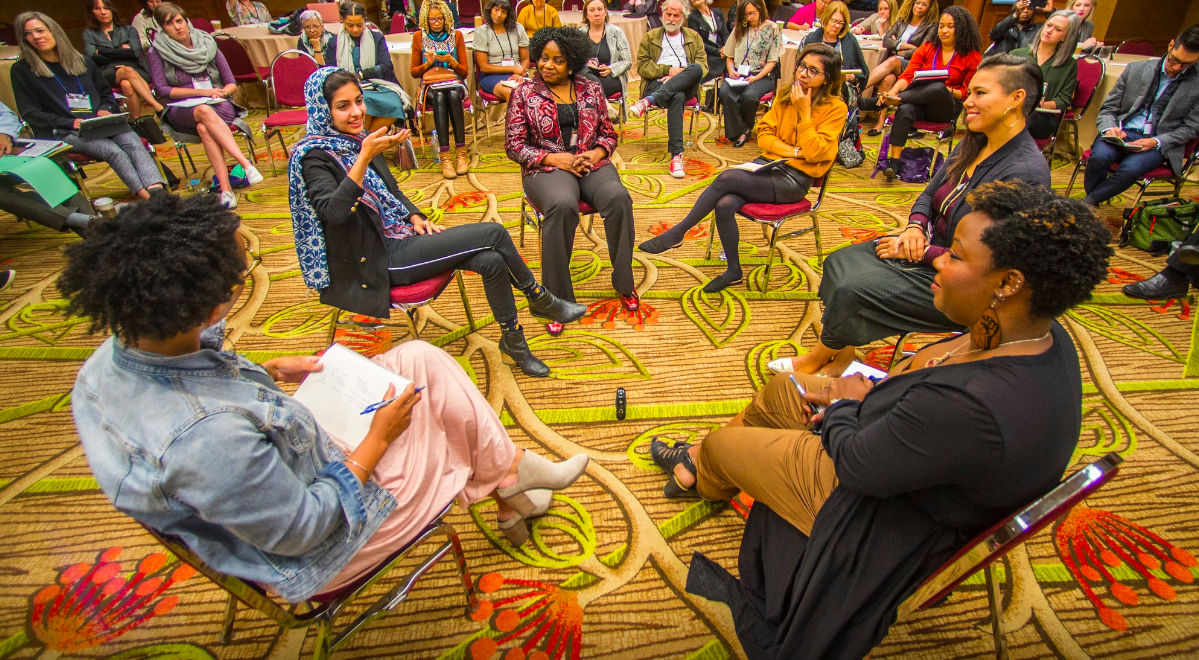
Image: A moment from the 2019 GIA Conference in Denver, Colorado – captured by Evan Semón
 Cultural Strategies Council